If These Boots Could Talk
How do you find story ideas for work?
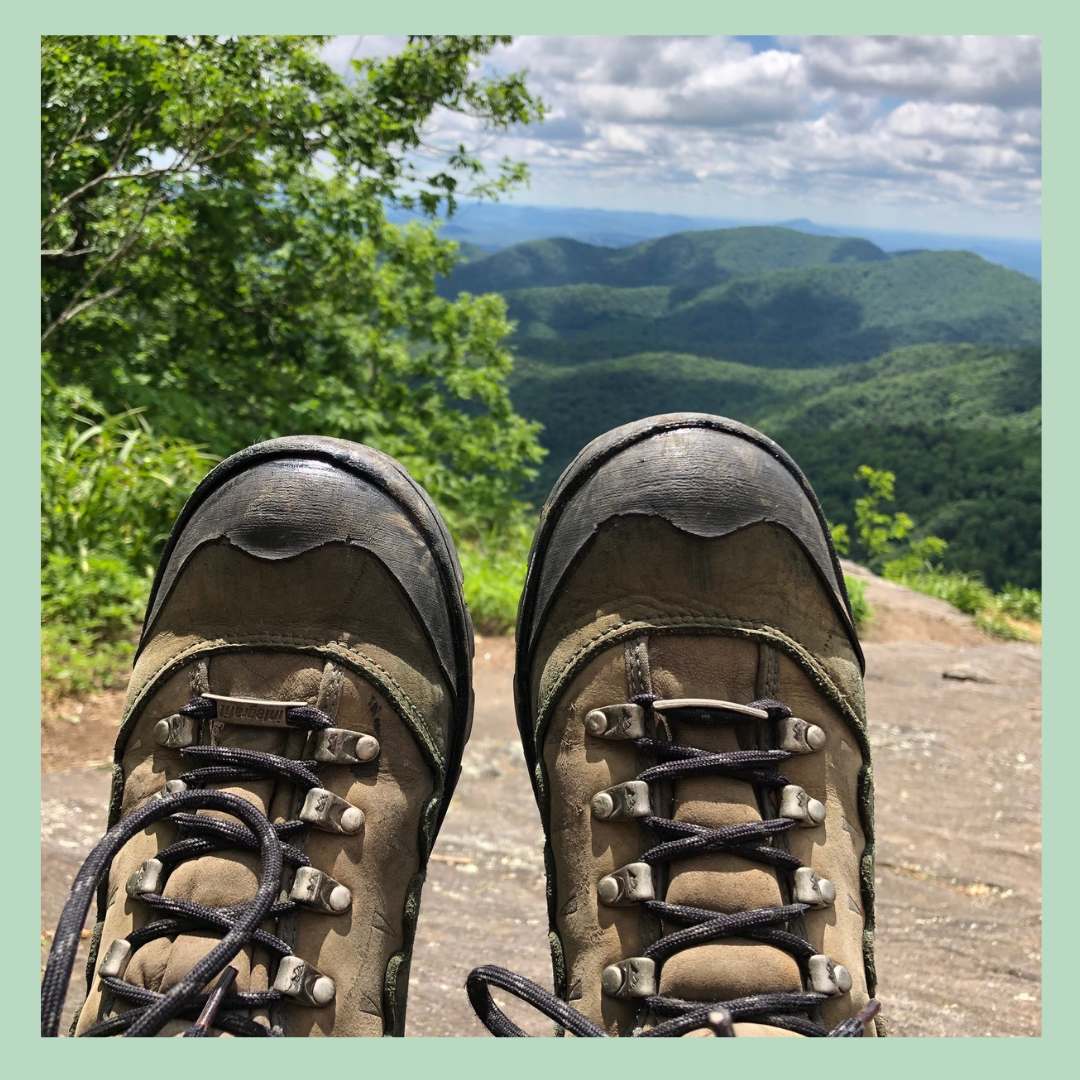
I took my hiking boots out a few weeks ago for a short trek on the Appalachian trail.
As I laced them up at the trailhead, I remembered buying them 20 years ago.
Standing parallel to the mirror in the outdoor store with different boots on each foot.
Balancing on one leg, the other bent up like a flamingo.
Did I want the one that was sturdy, stiff and heavy? Or the boot that was light and flexible?
I had no way of knowing those boots would follow me for 20 years across four continents and through water, snow, mud and dirt.
How they would hold the dirt and dust of Mayan ruins, national parks and ski mountains.
They would bear witness to the before and after September 11, 2001.
As I made my way along the Appalachian Trail, I kept thinking “If these boots could talk...”
My boots could be an excellent storyteller with endless ideas from our adventures together.
In a recent storytelling workshop, a participant asked “Where am I going to get ideas for stories? It feels like I am quickly going to run out of ideas.”
This is the most common question I get about storytelling. It is also the reason I find most people avoid storytelling.
Her moment of "A-ha!" came when she realized the things around her could serve as stories. Including inanimate objects. She wasn't limited to her personal or professional experience. Her limitation was really the time she left herself to find and work on a story.
Each person has hundreds of story ideas within themselves. They can tap into them by considering different perspectives.
One reason people struggle to find ideas for stories is that they are searching for perfectly formed stories.
Not fragments and ideas they turn into stories.
Stumbling across a fully formed story that doesn’t require work is about as unique as seeing a giraffe wearing a unicorn horn and pink feather boa walking down the street.
It doesn’t happen and is an unrealistic expectation.
Each person has hundreds of story ideas within themselves.
Ideas that can be taken and applied to many business situations.
You can use personal stories for business
Work stories don’t have to describe things directly related to the data or topic.
Sometimes the best stories are completely unrelated.
Tell stories with different settings, events and context to grab attention.
They don’t have to be business stories, they only need to reinforce the idea and action you want for your audience.
The story sneaks in a different idea and considerations in stealth mode, disrupting thinking, bias and "the way we do things."
I bought those hiking boots for a backpacking adventure with college friends four years after graduation. Despite months of planning, training, preparing equipment, and obtaining permits, we found ourselves in the backcountry, out of water and in bad shape. It was as if we were on a real-life ropes course, trying to come together to find our way out safely.
Hiking boots and running out of water may not seem like the ideal candidate for a story at work.
But they can help build many ideas and outcomes for an audience.
Ideas like being overconfident in planning and not having alternatives. How to use teamwork in stressful moments to figure out the path forward. Or the role of careful monitoring to recognize when shifts are needed in any successful outcome.
Start with the audience and define the outcomes you want them to know, think or do differently. Then identify and shape a story to reinforce those points.
Lean into emotions and make them lively. storytelling for business doesn’t need to be dull or boring.
Stories don’t have to have a hero
One of my storytelling pet peeves is how frequently Joseph Campbell’s “The Hero’s Journey” storytelling model is recommended for business.
It is complicated, rigid and assumes that your story has a hero.
A great story doesn't have to have a happy ending, someone to save the day or even describe a major transformation.
There was no hero as we hiked through the backwoods and ran out of water.
There were many mistakes and lessons learned.
Great stories build ideas, which often include sharing insights and lessons learned from mistakes.
Heroes are optional.
Perspective matters
You do not have to be the narrator of your story.
Imagine how different a story might be if it was told from the perspective of my boots.
If they told the story of adventures together or disasters averted?
They could connect to a whole other set of ideas and emotions.
When I am trying to stretch my creativity, I will often ask myself questions like “What would this story sound like if told by Elon Musk? What if I personified something like hiking boots - what story would they tell?”
How can you play with the perspective of the story?
Passage of time
I bought my boots in the spring of 2001.
The internet was accessed over dial-up. There wasn’t a cell phone in every pocket. Film was used in cameras. Driverless cars were a dream of the future. Unlimited liquids could be taken onto flights, and you could walk your friend to their gate to say goodbye at the airport.
Aviation, internet access, cell phones, cars and cameras each had a rich evolution over the past 20 years.
There are many stories to share in how each has changed over time, from the product itself to the problems solved.
When looking for stories, reflect on the role of the passage of time for the idea you want to build.
The spring day in 2001, I ended up choosing the heavy, sturdy boot.
I realized this week that if I had chosen the lighter, flexbile boot, they would be long gone.
They wouldn’t have held up to the wear and tear. We wouldn't have had as many adventures together.
Instead, I have boots for life.
Full of stories and adventures ahead.
***
Want to receive more articles like this one? Sign up for Brain Food here.