

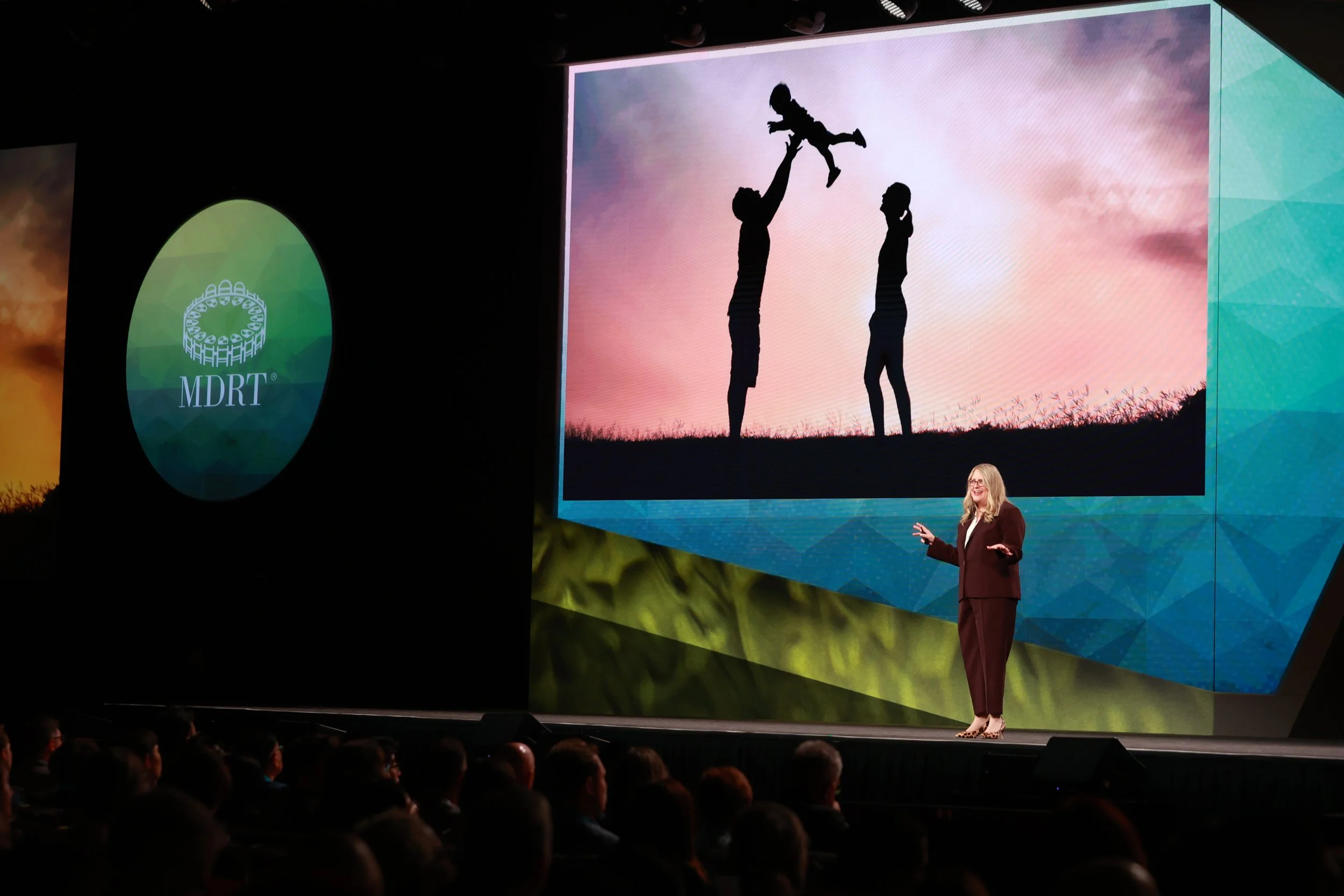
Frequently Asked Questions About Karen Eber’s Keynotes and Workshops
Section Styles button-center-mobile text-center-mobile
Frequently Asked Questions
Karen Eber is a keynote speaker, TED speaker, author of The Perfect Story, and Fortune 500 executive who helps organizations communicate with clarity, influence decisions, lead through change, and build stronger cultures through storytelling.
Known for combining neuroscience with practical business experience, Karen has educated and inspired more than three million people through keynote presentations, workshops, executive education, and her TED Talk on the neuroscience of storytelling. Organizations invite her back because audiences leave with practical communication frameworks they can immediately apply, not just inspiration that fades after the event.
Whether you're planning a leadership conference, annual meeting, sales kickoff, customer event, executive retreat, or internal learning program, this FAQ answers the questions event organizers most often ask about Karen's keynotes, workshops, speaking topics, customization process, and booking.
Click on a topic to jump to that section or scroll for the full list:
About Karen Eber ∣ Speaking Topics | Choosing a Storytelling Keynote Speaker | Industries & Audiences | Booking and Logistics |
Workshop and Learning Experiences | Presentation Style and Format | Social Proof and Credentials | Geographic Availability
About Karen Eber
-
Author of The Perfect Story: How to Tell Stories That Inform, Influence, and Inspire. She helps leaders communicate complex ideas more clearly, influence decisions more effectively, and build stronger relationships through the science and practice of storytelling. Her TED Talk on what happens in your brain when you experience stories continues to reach millions.
Before founding Eber Leadership Group, Karen spent more than two decades leading culture, leadership development, and organizational transformation inside global organizations, including serving as Head of Culture and Chief Learning Officer at General Electric and Head of Leadership Development at Deloitte.
She has held the jobs her clients hold — accountable for culture in a 90,000-person organization, leading teams through reorgs, integrating businesses during mergers and acquisitions, and getting skeptical executives to change how they work.
-
Karen is best known for helping organizations transform communication from simply sharing information to creating understanding. Her work focuses on helping leaders explain strategy, communicate change, present data persuasively, influence without relying on authority, and build cultures where people understand not only what they should do, but why it matters.
She is widely recognized for translating neuroscience into practical communication tools leaders use in presentations, meetings, customer conversations, and everyday leadership. Her Five Factory Settings of the Brain Framework shares neuroscience principles that influence how the audience understands, remembers, and acts on their messages.
-
Karen specializes in storytelling for business, leadership communication, organizational culture, executive communication, storytelling with data, and leading through change. Unlike speakers who approach storytelling primarily as a presentation technique, Karen studies how the brain naturally processes information, emotion, memory, and meaning. Her Five Factory Settings of the Brain framework explains why some communication approaches succeed while others create confusion or resistance. Her work is grounded in neuroscience and strengthened by decades of executive leadership experience.
For additional insights, read:
-
Organizations partner with Karen Eber in several ways depending on their goals.
She's best known as a storytelling keynote speaker, though clients also book her as a leadership keynote speaker or communication keynote speaker for conference keynotes, association keynotes, and annual meeting keynotes, including both opening keynote and closing keynote slots.
Many of her storytelling keynotes are booked with a hands-on component, giving audiences the chance to apply concepts while in the plenary room.
Beyond the keynote stage, Karen leads storytelling workshops, leadership workshops, and executive communication workshops for leaders, managers, and teams, and provides longer-term leadership development, executive coaching, and storytelling consulting for organizations building communication skills at scale.
Many organizations combine a keynote with a hands-on component, giving audiences the chance to apply concepts immediately, while in the plenary room.
-
Many storytelling speakers teach people how to tell better stories. Karen teaches leaders how to become better communicators. She helps audiences understand how people make sense of information, build trust, remember ideas, and decide to act. Karen's approach combines three elements rarely found together:
Executive experience. She has led culture, leadership development, mergers, and organizational transformation inside global organizations. She understands the challenges leaders face because she's been responsible for solving them.
Neuroscience. Every keynote is grounded in research explaining how people process information, remember ideas, and make decisions. Her Five Factory Settings of the Brain framework explains why techniques work, and her four-part story structure, context, conflict, outcome, and takeaway, gives audiences a repeatable way to apply it to any story.
Immediate application. Audiences leave with practical frameworks they can use immediately, not ideas that only work on a keynote stage.
-
Organizations typically hire Karen because they want to improve how people communicate, not simply how they present. Event organizers frequently choose Karen when they want participants to:
Communicate ideas with greater clarity
Increase influence without relying on authority
Explain strategy more effectively
Improve executive presence
Communicate data more persuasively
Build stronger relationships across teams
Lead through uncertainty and change
Create cultures built on trust and understanding
Rather than delivering motivation alone, Karen provides practical frameworks audiences continue using long after the event concludes.
-
Karen has spoken for organizations including Microsoft, General Electric, Kraft Heinz, Kate Spade, PwC, Meta (formerly Facebook), ADP, Johnson & Johnson, Home Depot, Citi, Deloitte, Ernst & Young, EyeSouth, Kaiser Permanente, Navy Federal Credit Union, the U.S. Department of Energy, the U.S. Olympic & Paralympic Committee, and the UAE Prime Minister's Office, among many others. Her audiences range from executive leadership teams and board retreats to global conferences with tens of thousands of attendees.
-
Karen's TED Talk, How Your Brain Responds to Stories — and Why They're Crucial for Leaders, explores the neuroscience behind why stories are one of the most effective communication tools available to leaders. Viewed more than 2.25 million times, the talk explains how stories influence attention, memory, understanding, and trust. Karen's keynote presentations expand on these ideas, showing audiences how to apply the science in leadership, business communication, and organizational change.
The talk is the foundation of everything Karen brings to the stage. Where the TED Talk introduces the science, her keynotes go deeper, giving audiences the specific frameworks, structures, and techniques to apply it.
Attendees don't just leave understanding why storytelling matters; they leave knowing exactly how to do it, whether they're pitching an idea, leading a team, presenting data, or navigating a difficult conversation.
Karen's keynotes build directly on the Five Factory Settings of the Brain introduced in her book, THE PERFECT STORY.
These neuroscience principles explain what makes a story land or fall flat. These principles run through every keynote, workshop, and consulting engagement, making her body of work unusually cohesive.
For event planners, the TED Talk serves as the best preview of Karen's style: clear, science-backed, warm, and immediately applicable. Audiences who have seen the talk often cite it as the reason they requested Karen for their event.
-
Karen is the author of The Perfect Story: How to Tell Stories That Inform, Influence, and Inspire, an award-winning book that translates the neuroscience of storytelling into practical communication frameworks for leaders. The book received the Axiom Business Book Award, International Book Award, two Goody Business Book Awards, and was selected as a Next Big Ideas Club Must-Read. It has also been translated into multiple languages, helping leaders around the world improve how they communicate. Many organizations provide copies to attendees as a companion resource following Karen's keynote or workshop.
-
The Five Factory Settings of the Brain is Karen Eber's signature framework explaining the predictable, biological ways every brain processes communication.
The premise: every brain is pre-wired with default responses to how information is delivered. When a message works with those defaults, it gets through, is remembered, and gets acted on. When it doesn't, the brain tunes it out no matter how important the message is.
She first introduced these neuroscience-based concepts in her book, THE PERFECT STORY, and they are foundational in her work.
The framework answers the questions your audience is already asking, even if they haven't articulated them: Why do some presentations stick while others evaporate the moment the slide deck closes? Why does data alone rarely change minds? Why do people remember the story from a keynote three years later but not the strategy deck from last quarter?
The Five Factory Settings appear across all of Karen's work: including her book THE PERFECT STORY, keynotes, and her workshops. They are a consistent, teachable language that teams can share and apply long after the event ends.
Clients frequently report that the framework becomes shorthand in their organizations: a common way of talking about communication, leadership, and influence that outlasts any single engagement.
This framework is what separates Karen's sessions from generic storytelling workshops. Attendees don't just hear that storytelling matters; they understand precisely why, and they have a repeatable system for doing it better starting the next day.
-
Karen teaches a four-part story structure, context, conflict, outcome, and takeaway, that works for any story rather than forcing one narrow format. Most story frameworks fail leaders in one of two ways: they're built for only one type of story, so a leader trying to land an idea in a meeting tries to force it into a shape that was never meant to hold it, or they're complicated enough that the leader gives up before making the point. This structure describes what every story needs rather than prescribing its shape, so it works whether someone's giving a two-minute answer in a meeting or a full keynote.
The framework first appeared in Karen's book, The Perfect Story, and was excerpted in Quartz.
-
Karen is the recipient of multiple awards recognizing both her thought leadership and contributions to leadership development. Her work includes:
Author of the award-winning book The Perfect Story
Four-time Association for Talent Development (ATD) Award winner
TED speaker with more than 2.25 million views
Karen has been widely featured in media including Fast Company, Forbes, Entrepreneur, Inc., Business Insider, Quartz, Chief Learning Officer, NPR, CNBC, and hundreds of podcasts
Guest lecturer at MIT Sloan School of Management, Stanford, London Business School, Purdue University, Porto Business School, and the Harvard Alumni Association
Speaking Topics
-
Karen's keynote presentations help organizations improve how people communicate, influence, collaborate, and lead. Every keynote is rooted in the neuroscience of how people understand information, though each program focuses on a different business challenge. Karen's most requested topics include three categories: Storytelling, Culture, and Leadership:
STORYTELLING
Storytelling That Informs, Influences, and Inspires: neuroscience-backed storytelling for leadership communication and executive presence.
Storytelling with Data: From Insights to Impact: transforming data into decisions through clear communication.
CULTURE
What Story Does Your Culture Tell?: How everyday communication shapes culture, trust, and employee experience.
What If Dolly Parton Wrote “9 to 5” Today?: How expectations around work and leadership have evolved and what leaders should do differently to adapt.
LEADERSHIP
Leading IS Change: Communicating with clarity and reducing resistance during uncertainty
The Human Advantage: Leadership Skills AI Can’t Replace: The communication skills that grow more valuable as AI changes how we work.
-
Karen's leadership keynotes treat communication as one of the defining responsibilities of effective leadership. Topics include:
Leadership communication
Executive communication
Storytelling for leaders
Executive presence
Leading through uncertainty
Influencing without authority
Communicating organizational strategy
Building trust
Strengthening culture
Developing communication as a leadership capability
Communicating in the age of AI
Rather than leadership theory alone, Karen provides practical frameworks leaders can immediately apply in meetings, presentations, coaching conversations, and organizational change. Karen’s leadership talks include The Human Advantage: Leadership Skills AI Can’t Replace and Leading IS Change.
For additional insights, read
-
Organizational culture is shaped less by mission statements than by everyday communication. The stories leaders tell, the behaviors they reinforce, and the decisions they make all contribute to the culture employees experience.
Karen's culture keynotes, What Story Does Your Culture Tell?, and What if Dolly Parton Wrote “9 to 5” today? explore topics including:
Building trust
Psychological safety
Leadership communication
Organizational values
Accountability
Employee engagement
Culture during periods of change
Drawing on her experience as Head of Culture at General Electric, she helps leaders understand how communication drives culture transformation every day.
For additional insights read:
-
Today's organizations rarely experience one change at a time. Leaders navigate continuous change, competing priorities, restructuring, new technologies, evolving customer expectations, and shifting market conditions.
Karen's Leading IS Change keynote helps leaders create clarity during uncertainty, explain the “why” behind organizational change, build alignment across stakeholders, anticipate resistance, and strengthen trust during transitions.
For additional insights read:
-
As AI changes how organizations create content and automate routine work, it increases the importance of uniquely human communication skills. Karen's keynote, The Human Advantage: Leadership Skills AI Can’t Replace, explores how leaders can strengthen the abilities technology can't replace: empathy, curiosity, judgment, trust, storytelling, and influence.
Rather than viewing AI as a replacement for human connection, Karen helps audiences understand how leaders can become more intentional about the conversations that require human connection.
For additional insights read:
-
Her foundational keynote Telling Stories that Inform, Influence, and Inspire teaches audiences why some stories move people to action and others fall flat, using the Five Factory Settings of the Brain framework.
Attendees learn her four-part story structure, context, conflict, outcome, and takeaway, for telling stories that inform, influence, and inspire in any context: presentations, leadership conversations, sales, or difficult feedback.
-
The Storytelling With Data: From Insights to Impact keynote addresses a universal problem: organizations are data-rich but story-poor.
Leaders share dashboards full of metrics and wonder why nothing changes.
Karen teaches audiences how to turn data into narratives that drive decisions instead of debates, a topic especially popular with technical and analytical audiences in healthcare, finance, and technology.
-
Yes. Many organizations face challenges that span multiple areas across leadership, storytelling, change, culture, or data. Karen often integrates several themes into a single keynote built around the organization's goals. A leadership conference might combine storytelling, executive communication, and change leadership, while a sales kickoff might emphasize storytelling, influence, and data.
Every engagement begins with a discovery process to determine the right combination for the audience.
-
The most successful keynote presentations begin long before anyone walks on stage. Great keynote speakers invest time understanding the audience, business priorities, conference theme, and desired outcomes so the presentation feels built for the event rather than delivered to it.
Karen customizes every keynote through a discovery process that typically includes conversations with organizers, research on the audience and industry, and, when appropriate, interviews with attendees. This preparation lets her tailor stories, examples, and recommendations to the people in the room while preserving the research-backed frameworks that make her keynotes actionable.
-
Standard keynote: 45–60 minutes
Extended keynote with Q&A: 60–75 minutes
Keynote + hands-on application session (same ballroom): 90 minutes–2 hours
Half-day workshop: 4 hours
Full-day workshop: 6–7 hours
Multi-day / combined programs available
Karen also participates in VIP sessions, fireside chats, panel moderation, and breakout sessions as add-ons to a keynote.
-
Karen delivers virtual and hybrid keynotes with the same energy and interactivity as in-person events, using professional camera, lighting, and audio setup and a pre-event tech check for every virtual engagement.
-
The best storytelling keynote speaker isn't necessarily the most well-known or entertaining. It's the one whose expertise matches your audience's challenges and your event's goals. When evaluating speakers, consider whether they have experience solving the problems your audience faces, whether their content is grounded in research and practical experience, and whether attendees will leave with ideas they can apply immediately.
Karen brings more than two decades of executive leadership experience at General Electric and Deloitte. She grounds every keynote in neuroscience rather than anecdote, and customizes each program to the audience and event goals — which is why event organizers consistently cite her preparation and actionable takeaways as reasons they invite her back.
-
The best keynote topic starts with the outcome you want to create. Choose Storytelling That Informs, Influences, and Inspires if you want attendees to communicate more effectively and build trust. Choose Storytelling with Data if your audience regularly presents financial results, analytics, or recommendations. Choose Leading IS Change if your organization is navigating transformation, restructuring, or growth. Choose The Human Advantage if your audience wants to understand how communication evolves alongside AI.
Rather than asking organizers to pick from a list, Karen starts by understanding what success looks like for the event:
What challenges is the organization facing?
What conversations do leaders need to have differently?
What behaviors should change after the keynote?
What should participants remember six months later?
Through the discovery process, Karen recommends the topic or combination that best fits.
-
A Storytelling with Data keynote is the right choice when a team regularly needs to turn numbers into decisions instead of debate. This is common among finance and FP&A teams, analysts, engineers, product managers, and executives. Karen's keynote helps these audiences move beyond presenting charts and dashboards to communicate insights that influence decisions, using data as a tool for influence and persuasion rather than just information.
-
Keynotes and workshops serve different purposes.
A keynote introduces new ideas and creates a shared experience for a broad audience in a single session.
A workshop gives a smaller, defined group hands-on time to practice a specific skill, get feedback, and apply concepts to their own work.
Choose a keynote if you want to energize a full conference audience or organization around a new idea or shared language. Choose a workshop if you have a specific group, like managers or a sales team, who need to build a skill, not just hear about it.
Many organizations do both: a keynote to build the common language, followed by a workshop so participants translate the ideas into lasting behavior change. Karen frequently combines both formats as part of leadership development and organizational change initiatives and can recommend the right mix during the discovery process.
-
The most memorable keynotes don't simply entertain — they change how people think. Event planners consistently report that memorable speakers challenge assumptions, make complex ideas easy to understand, balance research with real stories, and provide actionable takeaways that continue influencing conversations after the event. Karen designs every keynote around a single question: What will this audience do differently tomorrow? Her goal is to have ideas be memorable and accessible so audiences can apply concepts the next day.
-
Share your event goals, audience makeup, and the specific challenge you want addressed like a leadership transition, a data communication gap, or an organizational transformation. Karen's discovery process also benefits from knowing your industry, recent internal messaging or themes, and access to a few attendees for a short pre-event conversation, so the keynote feels built for your room instead of dropped into it.
-
Every engagement starts with a discovery call to understand your event, audience, goals, and timing. From there, Karen researches your industry and organization, often speaks directly with a few attendees or the organizer, and builds the keynote or workshop around your specific goals rather than delivering a standard talk. This process begins once the speaker agreement is signed and continues through pre-event calls up to the event itself.
Choosing a Storytelling Keynote Speaker
Industries and Audiences
-
Karen speaks across a wide range of industries because communication challenges are remarkably consistent regardless of sector. Her clients include organizations in technology, healthcare, financial services, manufacturing, consumer products, retail, energy, education, government, professional services, entrepreneurs, and nonprofit organizations. Although these organizations operate in different industries, they often face similar communication challenges:
Helping leaders explain change
Improving executive communication
Turning complex information into clear messages
Increasing collaboration across teams
Strengthening organizational culture
Improving decision-making
Helping technical experts communicate with nontechnical audiences
Because these challenges exist across industries, Karen's frameworks are designed to be broadly applicable while still being customized for each audience. Karen customizes every keynote with examples, stories, and applications relevant to the audience's industry.
-
Karen regularly speaks with executive leadership teams, people managers, sales and marketing teams, HR and talent leaders, learning and development (L&D) professionals, and technical functions including finance, engineering, legal, product, R&D, and data teams. Although these audiences do very different work, they all rely on communication to influence decisions, build relationships, and drive professional development across the organization.
-
Technical professionals are frequently experts in their field but receive little formal training in explaining complex ideas to nontechnical audiences. Karen's communication frameworks help engineers, analysts, and scientists present information in ways that are easier to understand without oversimplifying the content. Many organizations choose Karen specifically because she helps technical experts communicate with greater clarity and influence.
-
Absolutely. Senior leaders communicate constantly — with boards, investors, customers, and employees — and Karen's executive audiences appreciate that her work goes beyond presentation skills to address communication strategy, executive presence, and leading through uncertainty. Because Karen spent more than two decades in executive leadership roles herself, she understands these challenges firsthand.
-
Yes. Emerging leaders often have strong technical expertise but fewer opportunities to develop communication skills, and Karen helps them present ideas confidently, influence without formal authority, and build credibility early in their careers. The same neuroscience-based frameworks apply regardless of career stage, which is why mixed-experience audiences work well.
-
Karen regularly speaks at professional associations, industry conferences, annual meetings, and leadership summits. Because she customizes every keynote, she adapts examples and stories to reflect the priorities of each association's membership rather than delivering a generic presentation.
-
Karen has worked with nonprofit organizations, universities, healthcare systems, and government agencies. Although these sectors often operate under different constraints than for-profit businesses, they face similar communication challenges — leading change, influencing stakeholders, and building trust — and programs are customized to reflect each organization's mission and audience.
-
Karen regularly works with Fortune 500 companies, professional associations, government agencies, universities, healthcare systems, financial institutions, technology companies, nonprofits, and global conferences. A representative sample by industry:
Technology: Microsoft, GE, Facebook, Avanade, RSA Conference, Greenhouse, Square
Consumer & Retail: Kraft Heinz, Kate Spade, Stuart Weitzman, Tapestry, Home Depot
Financial Services: Citi, Guardian Life, ADP, Navy Federal Credit Union, Million Dollar Round Table
Healthcare & Pharma: Johnson & Johnson, EyeSouth Partners, Ardelyx, Kaiser Permanente
Professional Services: Deloitte, Ernst & Young, PwC
Government & Energy: U.S. Department of Energy, UAE Prime Minister's Office, U.S. Olympic & Paralympic Committee
Universities: MIT Sloan, Stanford, London Business School, Harvard Alumni, Purdue, Emory
-
Karen has spoken to executive teams of fewer than 30 people, leadership retreats, company town halls, and conferences with audiences exceeding 30,000. Her programs are designed differently depending on audience size, balancing interaction, storytelling, and practical application for each format.
Booking & Logistics
-
Submit an inquiry on the Speaker Inquiry page. You'll typically hear back within one business day. From there: a discovery call, a customized proposal with topic recommendations and fee details, a speaker agreement, and pre-event customization once the contract is signed.
-
Karen's fee varies based on event type, format, location, audience size, and the level of customization involved. Virtual and in-person engagements are priced differently, and multi-event or bundled arrangements are available for organizations booking more than one engagement.
For current availability and fee information, contact Karen's team directly or reach out through her speaker bureau representatives. Her team responds within one business day and will provide everything you need to move forward.
The best starting point is a brief conversation about your event once Karen's team understands your objectives, audience, and format, they can give you accurate information and explore what's possible.
-
Yes. Karen can be booked directly through her website or through your preferred bureau. Just let them know you're interested in booking her.
-
Most events book three to nine months out. Peak conference season (September–November and February–May) fills quickly. If your event is within three months, reach out anyway — availability may exist, but act quickly.
-
A signed speaker agreement and a deposit confirm the date. Soft holds are available for a limited time while you finalize internal approvals.
-
Yes, when requested. She often stays for meals, networking, VIP engagements, and other program elements. Event planners report this deepens attendee connection.
-
Yes, with advance notice Karen can participate in run-throughs, VIP functions, and press interviews.
-
Yes. She conducts AV checks and production run-throughs for timing, transitions, and multimedia alignment.
-
Wireless lavalier or Countryman microphone, confidence monitor with visible timer, and the ability to project PowerPoint slides. A full tech rider is available on request once booking is confirmed.
-
Yes, at least one for every engagement, with additional sessions for multi-stakeholder events. She may also request to speak with a few attendees to inform the stories and examples she uses.
-
Yes. Many organizations purchase copies of The Perfect Story for attendees, with volume discounts available through a vendor partner. Reach out during booking to arrange this.
Book purchases are handled through a vendor partner, and volume discounts are available. Karen's team can connect you with the right option based on your order size and timeline. Reach out during the booking process and we will take care of the details.
-
Event planners consistently describe her as one of the most collaborative and prepared speakers they've worked with — communicating clearly, participating fully in pre-event prep, and adapting when plans change.
Workshops & Learning Experiences
-
In addition to keynote presentations, Karen designs highly storytelling and storytelling with data workshops that help participants move from understanding communication concepts to applying them in daily work. While keynotes create shared understanding, workshops give participants the opportunity to practice new skills, receive coaching, and apply what they learn to real business situations — customized to the organization's goals and audience rather than delivered as standardized training.
-
Popular workshop topics include Storytelling for Business, Storytelling for Leaders, Storytelling with Data, Executive Communication, Leadership Communication, Executive Presence Through Communication, Leading Is Change, Building Trust Through Communication, Influencing Without Authority, and Communicating in the Age of AI. Each workshop is customized to the organization's goals, industry, and audience rather than following a fixed curriculum.
-
Attendees receive practical frameworks, tools, and reference materials they can apply immediately. Many organizations also purchase The Perfect Story as a companion to the keynote. Karen also offers Brain Food, a free biweekly newsletter on storytelling, leadership, and culture.
-
Yes. As a storytelling consultant, Karen offers advisory conversations, virtual check-ins, and ongoing consulting for organizations embedding storytelling as a leadership capability, plus 1:1 coaching for senior leaders and longer-term consulting on leadership development, culture transformation, and team building through Eber Leadership Group.
Presentation Style and Format
-
Audiences describe Karen as “a friend on stage,” citing her warmth, energy and immediately engaging style. They enjoy her ability to combine science-backed content with real stories, humor, and audience participation. Her style works equally well in a 9,000-person ballroom and a 40-person executive offsite.
-
Every engagement includes a pre-event discovery process: reviewing event goals and theme, researching the industry and audience, and often speaking directly with the organizer.
-
Karen adjusts depth, examples, and delivery for C-suite leaders, managers, frontline teams, member organizations, and mixed-experience groups.
Geographic Availability
-
Karen is based in Atlanta, GA and speaks across nationwide, traveling regularly to Atlanta, Austin, Boston, Charlotte, Chicago, Dallas/Fort Worth, Denver, Houston, Las Vegas, Los Angeles, Miami, Minneapolis, Nashville, New York City, Orlando, Phoenix, San Diego, San Francisco, Seattle, and Washington D.C., plus regional and mid-sized markets. Virtual events extend her availability everywhere.
-
Karen has delivered keynotes across North America, Europe, Africa, and beyond. Many of her keynotes have been given with simultaneous translation.
International engagements are quoted individually based on travel logistics and program scope.
Social Proof and Credentials
Event organizers consistently describe Karen as collaborative, prepared, and easy to work with, with preparation that begins well before she takes the stage through research and discovery conversations. Because every keynote is customized, audiences experience presentations that feel designed specifically for their event rather than adapted from a standard talk. Organizations appreciate that the practical frameworks she provides continue influencing communication and leadership long after the event ends.
"Karen infuses you with confidence while making storytelling approachable and relatable." — Microsoft
"This clicked more than other storytelling experiences: excellent information, tools, and techniques." — PwC
"The keynote was the 'talk of the town' with people discussing how to incorporate the strategies." — AALHE
"Exceptional speaker with storytelling techniques and tools that resonate across all levels." — GE
"Phenomenal, interactive session that helped us identify strengths, opportunities, and actions." — Kraft Heinz
"One of the highest-rated sessions ever!" — Coaching.com Summit
"Hugely impactful presentation that understood our messaging and business." — Ardelyx
“So many a-has about what makes a great story and how they influence purchasing decisions.” — Facebook
“A delight to work with from start to finish!” — Million Dollar Roundtable
“The presentation was truly captivating and resonated deeply with our audience.” — Citi
Author of The Perfect Story, Axiom Business Book Award, International Book Awards, two-time Goody Business Book Award, Next Big Ideas Club must-read, translated into four languages
One of the top TED Talks on storytelling: How Your Brain Responds to Stories and Why They're Crucial for Leaders
Former Head of Culture and Chief Learning Officer at General Electric (90,000 employees, 150 countries)
Former Head of Leadership Development at Deloitte
Four-time Association for Talent Development (ATD) Award winner
Featured in Fast Company, Forbes, Inc., Entrepreneur, NPR, CNBC, Business Insider, and hundreds of podcasts
Guest lecturer at MIT Sloan, Stanford, London Business School, Purdue, Emory, Porto Business School, and for Harvard Alumni Association
Yes, for public events she can post pre-event, day-of, and post-event content across her channels when requested. Additional arrangements (LinkedIn posts, reels, podcast interviews, Instagram features) can be discussed during booking.