Karen Eber
Change Management Keynote Speaker
Leading IS Change
Helping leaders navigate mergers, reorganizations, leadership transitions, and AI disruption without losing trust, focus, or momentum because change doesn't have a beginning and an end anymore.




Keynote Overview
Leading IS Change
Most change management models assume change is an event: announce it, manage the disruption, and help people reach the other side. That approach worked when organizations experienced change in distinct phases with time to recover in between.
That world is gone. Change now arrives continuously. A strategy shift overlaps with a reorganization, which overlaps with an AI rollout, which overlaps with market uncertainty. There's no "other side" because the next change has already begun. When change becomes constant, it stops being something leaders manage. It becomes the environment in which leadership happens.
Drawing on her experience leading culture at General Electric and leadership development at Deloitte, Karen Eber shows what it takes to help people stay focused, adaptable, and productive when the ground doesn't stop moving. Combining neuroscience, organizational psychology, and practical leadership experience, she gives audiences a modern approach to leading through continuous change.
Her central idea is simple: change management can't be a separate initiative activated during disruption. It must be embedded in how leaders communicate, make decisions, and build trust every day. Leadership doesn't happen alongside change. Leading IS Change.
Audience Takeaways:
Understand how the brain responds to uncertainty and why it shapes people's willingness to embrace change.
Replace episodic change management with an ongoing leadership practice built for continuous change.
Communicate with greater clarity to reduce resistance and increase engagement.
Help people focus on what's known, meaningful, and within their control during uncertainty.
Build trust even when leaders don't yet have every answer.
Align business, talent, and culture decisions so change efforts reinforce one another instead of competing.
Format: 45–60 minutes | Any audience size | In-person or virtual
stylus Who is This Keynote For?
Karen speaks to organizations navigating change that has stopped being a single event including:
Executive leadership teams and boards leading through restructuring, M&A, or strategic pivots
CEOs, CHROs, CLOs, and People/Culture leaders responsible for change adoption
Middle managers and team leaders closest to employees during change, and most responsible for how it's experienced
Organizations integrating AI and redefining roles, workflows, and productivity
Fast-growing or newly merged companies where “how we do things” is being rewritten in real time
show_chart Why Organizations Hire This Keynote:
Organizations bring Karen in when they need leaders be equipped to navigating change as a constant, including to:
Help leaders and managers guide teams through change without adding to the chaos
Reduce the trust-eroding effects of over-rotation and rigid mandates issued in reaction to one data point or one loud complaint
Replace one-size-fits-all change communication with messages that actually land for different audiences
Build change capability into everyday leadership, not rolled out as an initiative
Support teams and individuals through mergers, reorganizations, leadership transitions, and AI adoption
Redefine productivity and focus as roles and workflows shift

What Makes Karen Eber’s Change Management Keynotes Different?
Most change management speakers teach change as an event to survive: a model, a burning platform, a communication plan, a finish line.
Karen teaches change as a leadership capability to build. In her experience, that finish line stopped existing long ago.
Many change management models are dated and lagging. Leaders need a different approach to infuse change management throughout their leadership and not treat it as a separate model.
She isn't a consultant who studies change management from the outside.
As former Head of Culture for a General Electric business, and Head of Leadership Development at Deloitte, she led people through mergers, restructurings, and organization-wide transformations.
She knows how to align audiences and avoid the things that make change fail.
-
Grounded in Neuroscience
This approach is same research behind her Five Factory Settings framework and her book, The Perfect Story on how the brain decides what to trust, focus on, and act on under pressure.
-
Built for Leaders
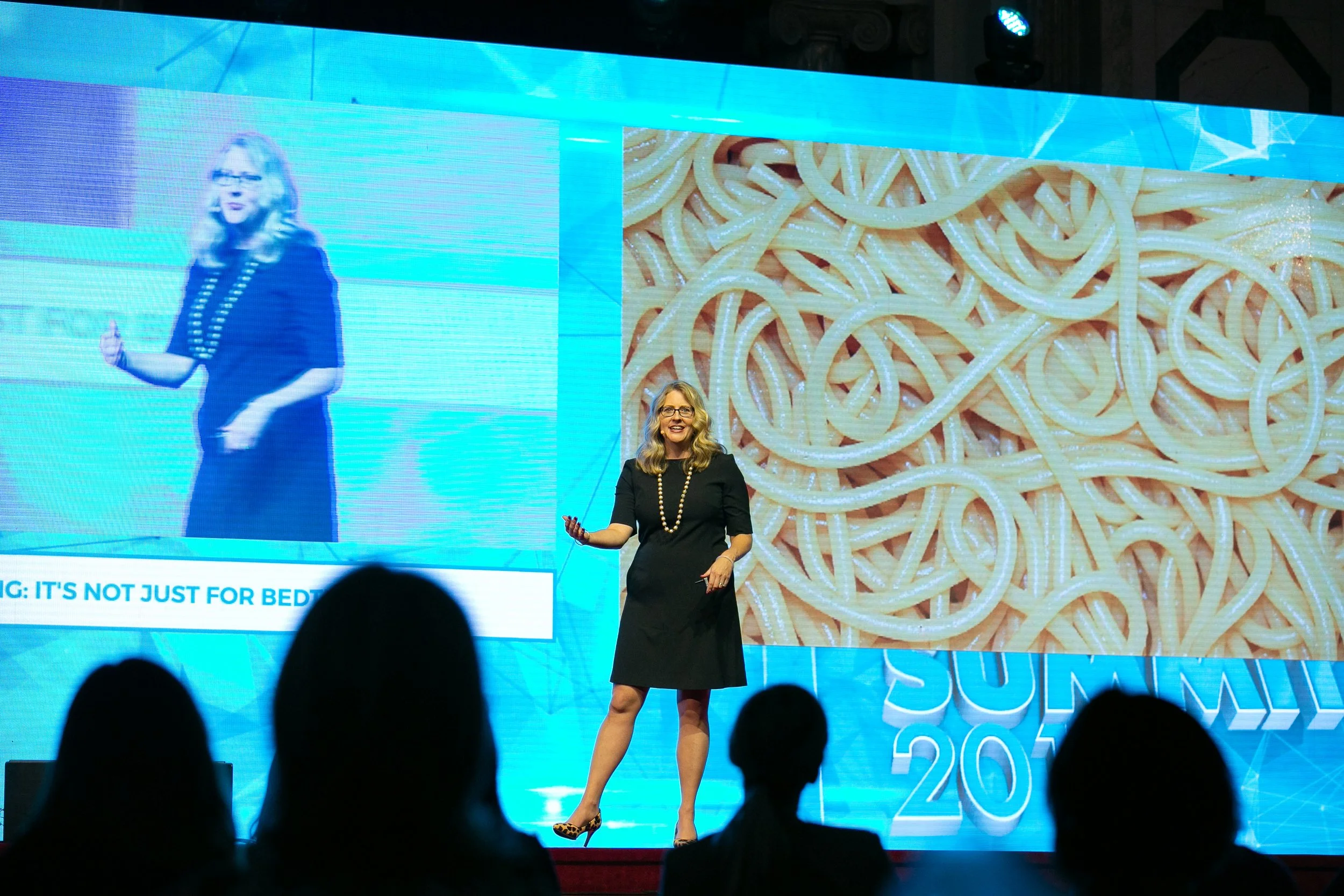
Make Waffles, Not Spaghetti how to help employees focus on what's known and in their control during change, instead of getting tangled in everything that isn't.
Sitting in the And why leaders over-rotate under pressure, and how to catch it before a reasonable guideline becomes a rigid mandate that erodes trust.
-
Avoid Common Mistakes
Most change communication fails by assuming everyone shares the sender's excitement, and how to build messages for the people who are neutral or opposed, not just the ones already on board.
Want more on Karen's background and how she works with organizations? Visit the About page or the Speaking FAQ.
Section Styles video-corners
See Karen Speak


Why this Keynote Matters Now
AI, restructuring, and market uncertainty mean most organizations are no longer moving through change — they're living inside it, permanently.
Leaders who were trained to manage change as a temporary disruption are running out of runway.
The leaders who thrive next will be the ones who stop waiting for stability to return and learn to lead well without it.
Common questions this keynote answers:
How do you lead a team through change?
Why does change management fail?
How do you communicate change to employees?
What is over-rotation in leadership?
How do you help employees navigate constant change?
What are the biggest change management mistakes leaders make?
How do you build trust during a reorganization or merger?
What makes change management communication fail?
How do you avoid over-rotating on a leadership decision?
For more insight behind this keynote, read The Complete Guide to Leading Through Change.
Frequently Asked Questions About Change Management Keynote
-
A change management keynote is a conference or corporate event session that helps leaders and employees understand, communicate, and lead through organizational change, such as a merger, restructuring, leadership transition, or technology rollout — with less resistance and more trust.
-
It's a keynote on why traditional change management no longer matches how change happens inside organizations today. Change can no longer be treated as an initiative or single event with a beginning and an end. Karen shows leaders how to build change capability into everyday leadership, using frameworks drawn from her experience leading culture and change at General Electric and Deloitte.
-
Most change management speakers offer a model for managing a single change event: communicate the vision, manage resistance, land the change. Karen's position is that this model no longer fits, because change today rarely has a beginning and end. It’s messy, accumulates, and overlaps. Her keynote focuses on building an ongoing leadership capability instead of a one-time communication plan.
-
Karen led culture and change from the inside as Head of Culture for a General Electric business and Head of Leadership Development at Deloitte. Her frameworks are also grounded in the neuroscience research behind her book, The Perfect Story, and her Five Factory Settings framework.
-
Executive leadership teams, CHROs and People/Culture leaders, and middle managers navigating restructuring, M&A, leadership transitions, or AI adoption. Anywhere leaders need to help teams perform through ongoing, overlapping change rather than a single change event.
-
Karen tailors examples and language to the specific change an organization is facing through pre-event conversations with organizers.
-
They share the same underlying view. Culture and change are not separate initiatives but ongoing leadership practices that focus on different questions.
The culture keynote asks what story your organization's everyday behavior is telling. This keynote asks how leaders help people function and perform while that story is actively being rewritten.
Organizations facing both a culture moment and a change initiative often book them together.
-
The same Five Factory Settings framework from Karen's book explains why change communication built around the sender, instead of the audience, tends to fail. This keynote applies that framework specifically to leading and communicating through change.
Have additional questions? Planning a keynote often comes with questions about topics, customization, workshops, travel, audience size, fees, and what to expect. Visit the Frequently Asked Questions page for answers to many of the questions organizers ask before booking Karen.

Book Karen Today
-

"Karen infuses you with confidence while making storytelling approachable and relatable."
Cyber Security Solution Architect
-

"This clicked more than other storytelling experiences: excellent information, tools, and techniques."
Head of Digital Learning
-

"Exceptional speaker with storytelling techniques that resonated across all levels."
CHRO, Power Business
-

"The presentation on storytelling was truly captivating and resonated deeply with our audience."
Enterprise Executive Leadership Development
-

"So many a-has on what makes a great story and how they influence purchasing decisions."
Marketing Strategy Leader
-

"This was the best storytelling experience: clear structure, tools, and insights!"
Head of Alumni Events
-

A delight to work with from start to finish!
Program Planner
-

"Phenomenal interactive session that felt intimate despite a large group."
VP Digital Transformation
-

"Hugely impactful presentation that understood our messaging and business."
VP Sales
-

"Keynote was the "talk of the town" with people discussing incorporating the strategies."
Program Planner
-

"Karen's presentation was a highlight of our conference."
Executive Director
-

"One of the highest-rated sessions ever!"
CEO