The Meeting Designed by Spies
Did you know your Monday morning meeting was designed by spies?
In 1944, World War II was in its final throes. The Allies were holding their own, but they lacked reserves. They needed more than troops; they needed leverage. They began recruiting people across German-occupied Europe who were sympathetic to the Allied cause and wanted the war to end. These were ordinary citizens who could create local impact.
The Axis countries relied heavily on factories and businesses to sustain their war efforts. Production was redirected toward tanks, trucks, aircraft, weapons, and military equipment. Textile factories made uniforms and parachutes. Railroads and shipping companies moved troops and supplies across territories. All revenue and items produced helped fuel the war. If factories were the engine, slowing them down could shift the outcome.
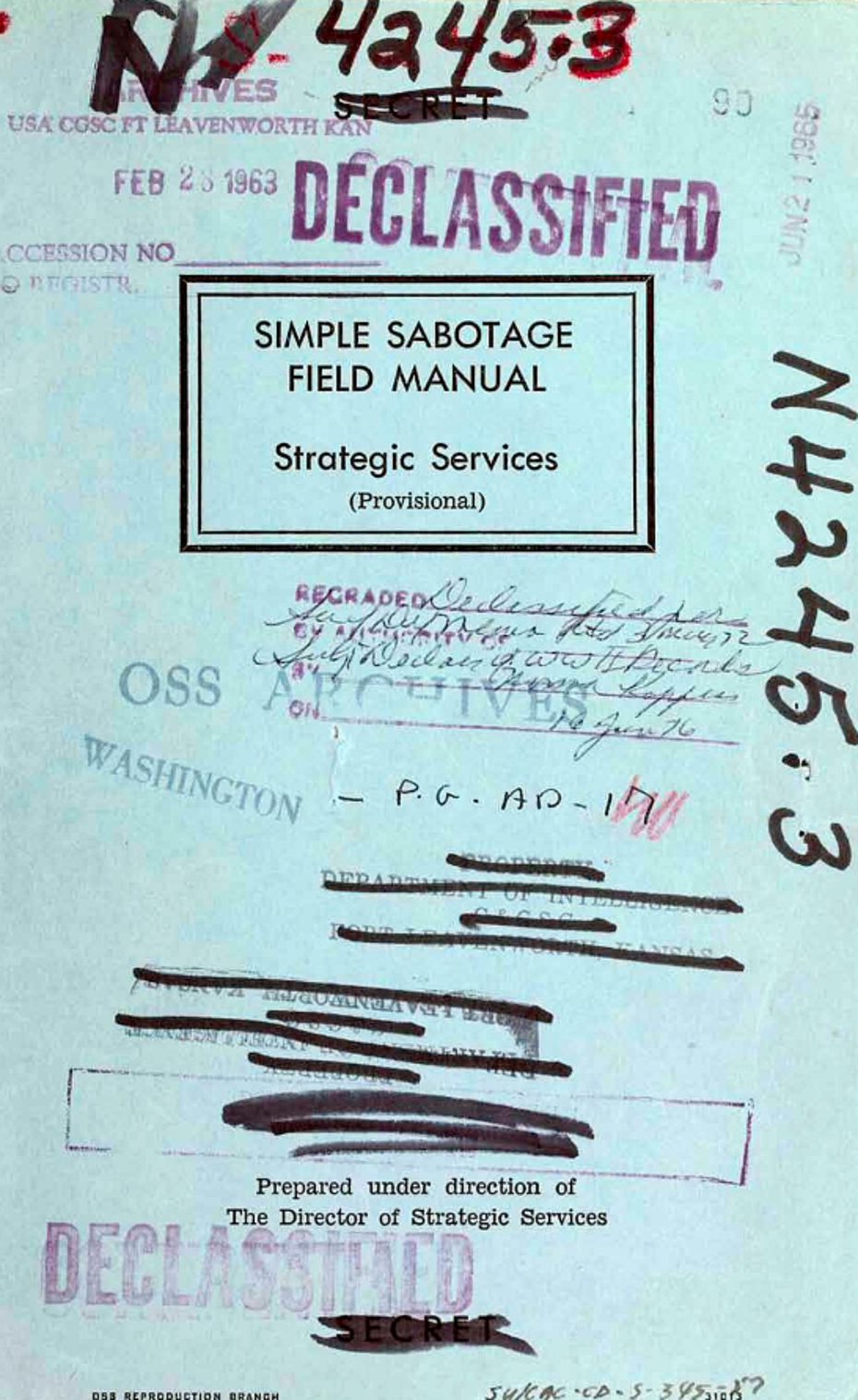
The Office of Strategic Services (OSS), a precursor to the CIA, created a guide. It outlined ways to equip everyday people to subtly disrupt operations from within. The Simple Sabotage Field Manual was distributed to OSS officers to train what they called “citizen saboteurs.”
It defined sabotage as:
“Innumerable simple acts the ordinary individual citizen-saboteur can perform. Simple Sabotage does not require specially prepared tools or equipment; it is executed by an ordinary citizen who can carry things out in such a way as to involve a minimum danger of injury, detection, and reprisal.
This type of activity, sometimes referred to as the "human element," is frequently responsible for accidents, delays, and general destruction under normal conditions. The potential saboteur should discover what types of decisions and non-cooperation are normally found in his kind of work and devise his sabotage to enlarge that "margin for error."
Some of the suggestions for factories included:
Keep factories cluttered and susceptible to fire. Leave saws twisted so they will break. Let tools dull. Ruin stock by setting off sprinklers by smacking the sprinkler head. Put sugar or sand in gas tanks.
My personal favorite:
Any audience member can ruin a propaganda film by bringing a bag of moths into the theater: “Take the bag to the movies with you,” and leave it on the floor of an empty section of the theater. “The moths will fly out and climb into the projector beam, so that the film will be obscured by fluttering shadows.”
But perhaps most intriguing were the suggestions for how to sabotage from inside a business.
Employees were encouraged to:
Bring up irrelevant issues as frequently as possible.
Haggle over precise wordings of communications and resolutions.
Insist on doing everything through channels. Don’t take shortcuts to accelerate decisions.
Make speeches. Talk as frequently as possible and at great length. Illustrate your ‘points’ by long anecdotes and accounts of personal experiences.
When possible, refer all topics for ‘further study and consideration.’ Attempt to make the committees as large as possible — never less than five.
Bring up a topic decided upon at the last meeting and attempt to re-open for debate and questioning of the decision.
Advocate ‘caution.’ Be ‘reasonable’ and avoid haste which might result in embarrassments or difficulties later.
Managers were encouraged to:
· Misunderstand orders. Ask endless questions and quibble over details.
· Insist on perfect work in unimportant products; send back items for minor flaws.
· Give incomplete instructions when training new workers.
· Promote inefficient workers to lower morale and productivity.
· Multiply the procedures and approvals so that three people must approve what one could.
If you’ve been in a corporate meeting, these feels so familiar because you’ve seen it play out. While today the language has softened to things like “Circle back,” “Let’s loop in others,” and “We should form a working group,” the behaviors are the same.
How did actions once designed to sabotage organizations become accepted as best practices for running them?
After the war, many of the military and bureaucratic structures found their way into corporations. Hierarchy, chain of command, and layers of approval felt familiar and professional, especially as millions transitioned from military service into a rapidly expanding industrial economy. Growing organizations needed coordination, and bureaucracy scaled more reliably than improvisation.
At the same time, management theory was taking shape in the 1950s and 1960s. Business school codified practices that emphasized structure, consistency, and control. Formality became a sign of legitimacy. Complexity was mistaken for rigor.
A generation of leaders was trained in these systems. Everyone who followed inherited the behaviors as “The way work gets done.” Over time, people became risk-averse. The stopped experimenting, and the behaviors calcified.
Organizations began rewarding the appearance of diligence over actual output. Long meetings signaled effort and brevity indicated a lack of care. With enough repetition, these patterns became embedded and unquestioned.
Over decades, people settled into the identity of “We’ve always done it this way.” Sameness was rewarded. If you questioned inefficiency, you became the problem, not the process. Responsibility became diffused. When everything runs through committees and layers, no one owns the dysfunction, so no one fixes it.
Meanwhile, the rise of middle management created a new pressure: to justify the complexity being managed. This led to social signaling and performative busyness. Things like back-to-back meetings, endless email chains, and status updates signal value without measuring actual output.
These behaviors persist 80 years later because they’ve been normalized into the story of work. Organizations run on the stories they tell about how work should look. Bureaucracy is a story. Busyness is a story. Minimizing risk is a story. The meeting that could have been an email is a story. Each one signals what is valued.
If you want to shape behavior and drive change, you have to look at the story your culture is telling. People won’t remember your bullet points. They'll remember the moment they realized their Monday morning meeting might have something in common with a wartime sabotage manual.
The story works because it’s surprising. It reveals how when small everyday actions are multiplied across people, massive impact can be created. In one context they helped slow a war. In another, they quietly slow organizations. Once you see it you can’t unsee it. Once you see it, you can change it.
The OSS understood that the most durable form of damage is narrative. Stories shape behavior at scale.
If unexamined stories can sabotage an organization, intentional ones can rebuild it.
The question isn’t whether your culture is telling a story.
It’s whether it’s one you would choose.
***
*The Simple Sabotage Field Manual was declassified by the Central Intelligence Agency in 2008. You can download and read the whole PDF today.
Karen Eber is an author, TED and keynote speaker, and communication strategist who works with frontline leaders, senior executives, and C-suite teams at Fortune 500 companies. She partners with teams across sales, marketing, communications, HR, finance, operations, legal, and IT. She works across industries including healthcare, technology, financial services, manufacturing, energy, consumer goods, retail, professional services, education, and nonprofits — helping leaders turn complex information into clear, compelling stories that drive decisions and action. She is the author of The Perfect Story. Learn more about her keynotes and workshops at kareneber.com/speaking.