The Human Era: Why Authentic Communication Matters More Than Ever in the Age of AI
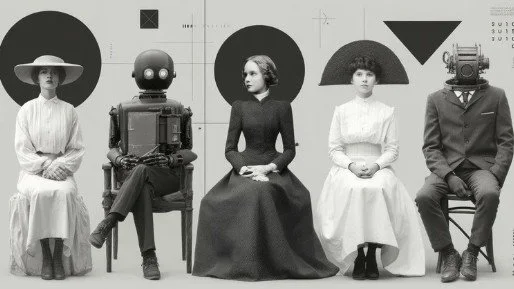
A post recently went around LinkedIn breaking down why people think Tony Robbins uses AI for his posts. Ironically, one person made a witty observation about it, and everyone else started repeating it.
Here’s the screenshot of the Tony Robbins post used for the example.
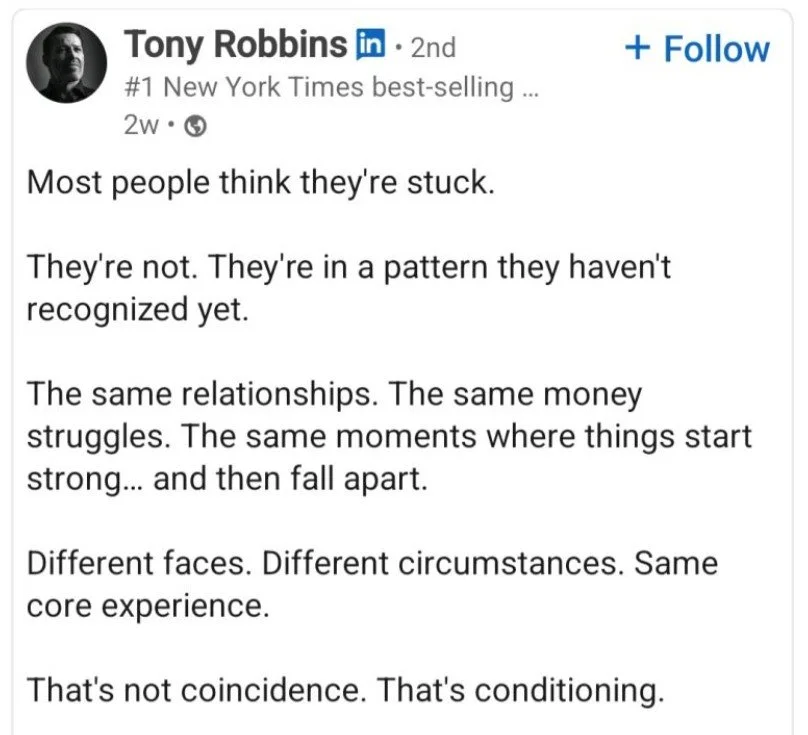
People started dissecting the structure of the post itself:
“This is four sentences with four AI formulas stacked together:
Most people think X. They're not. They're actually Y.
The same X. The same Y. The same Z.
Different X. Different Y. Different Z.
That’s not X. It’s Y.”
Most of these posts complained that Tony was using AI instead of his own stories and experiences. As if Tony actually writes his own posts. I highly doubt Tony Robbins is sitting around managing his content calendar and writing hooks. Yet people dissect these posts as though he is the one behind the computer and using ChatGPT to write them. (And yes, his content team is being lazy.)
What We’re Reacting To
These posts aren’t about sentence structure. They’re reacting to the feeling that no real person is present. They’re formulaic and lack real personality and insights.
With the AI era comes the AI police. People try to catch something they think is AI. First, it was outing every post that used an em dash, offending authors who have used them for decades.
Then came the “It’s not this, it’s that” finger-pointing. Calling out the sentences with a repetitive structure and little variation in cadence or length. Or noting when the copy includes words like “quietly.”
Another painful accusation: “citing things in threes.” I’ve written this way since high school. It’s part of my rhythm. I think in threes, give examples in threes, and love using them with alliteration (hint: see the title of my book… done long before AI entered the picture).
The AI police love catching something in the act, as though the person has committed an egregious offense and should be publicly shamed. They are also adept at pointing out presentations and websites created by Claude. There’s a distinct style: columns, takeaway headlines, supporting paragraphs, and perfectly balanced layouts. When everything looks the same and feels the same, it’s competent, but forgettable.
They are even calling out AI-generated headshots with skin and backgrounds so flawless they look better than Photoshop. It’s like the punch buggy game we played as kids, where everyone yelled the moment they spotted a Volkswagen Beetle. Each of these moments is called out with glee as though someone was caught in the act of a crime. But they’re really pointing out the absence of humanity.
Project Hail Mary
Earlier this summer, the movie Project Hail Mary opened to record numbers. Audiences loved the fresh story that wasn’t a remake. The directors, Phil Lord and Christopher Miller, repeatedly emphasized that the film used no green or blue screens during principal photography. They built physical sets and had Ryan Gosling act with a puppet operated by the actor James Ortiz.
That translated to the story. Timing, eyelines, and reactions felt organic. Audiences responded to the relationship between Ryland Grace and Rocky because it felt emotionally real and not rendered in post. The same principle applies to content. Audiences can feel when something comes from you versus assembled in a digital void.
Craving Humanity
When we suspect something is AI-generated, we often lose interest. Not because technology itself is bad, but because it can feel like no real person is behind it. We crave perspective, emotion, imperfections, and lived experience. People would rather connect with something authentic than consume another polished but forgettable piece of copy. When we can’t find evidence of the person behind the work, something feels missing and the brain tunes out.
AI will absolutely become part of nearly every aspect of our lives. But I don’t think this is the era of AI as much as it is the human era. The more we rely on tools and technology, the more important it becomes to make room for humans to show up as vulnerable, awkward, flawed, and genuine. Ironically, imperfections are often what make someone believable. If we can’t see you in it, we don’t want it.
Accidentally Outsourcing Ourselves
It’s tempting to default to AI to do our thinking. When you’re pressed for time and need to get things done, it’s comforting to type in some prompts and see what comes up.
“It knows me and my voice, so it’s ok!”
When you scan the results, you feel a sense of relief with compelling ideas. You think, “There’s something in here I can use.” Instead of thinking critically, you grab and go.
But what’s missing is you.
Reconnect With Your Thinking
When I was in grad school, one of my professors gave us a case study. We had a few minutes to solve the problem in teams. My team read the problem and immediately jumped into solutions. We forgot to ask questions and define what we were trying to do.
Sure enough, we skipped critical steps and missed key information. During the debrief, I was struck by how different the outcome could have been if we had simply started with asking ourselves a few questions.
When I am working on content or solving a problem, I use the four questions below to begin organizing my thinking. These questions help me identify what I’m missing, where I need more information, and how I actually want to approach the idea.
What am I trying to do here? What problem am I trying to solve?
What is my perspective?
What questions do I want to answer?
What am I unsure about?
AI tools are so great at augmenting your ideas or helping you see things that may be lacking. But when you default to them, you starve audiences of your thinking and the experience of you.
Nothing is original. Most ideas have already been explored. Walk into any library or bookstore and you’ll find endless books on leadership, storytelling, communication, and culture.
But people aren’t looking for information alone. They’re looking for a point of view, and someone whose experience helps them see things differently.
It hasn’t been done by you.
Karen Eber is an author, TED and keynote speaker, and communication strategist who works with frontline leaders, senior executives, and C-suite teams at Fortune 500 companies. She partners with teams across sales, marketing, communications, HR, finance, operations, legal, and IT. She works across industries including healthcare, technology, financial services, manufacturing, energy, consumer goods, retail, professional services, education, and nonprofits — helping leaders turn complex information into clear, compelling stories that drive decisions and action. She is the author of The Perfect Story. Learn more about her keynotes and workshops at kareneber.com/speaking.