Storytelling Lessons from Jackie and Shadow the Bald Eagles
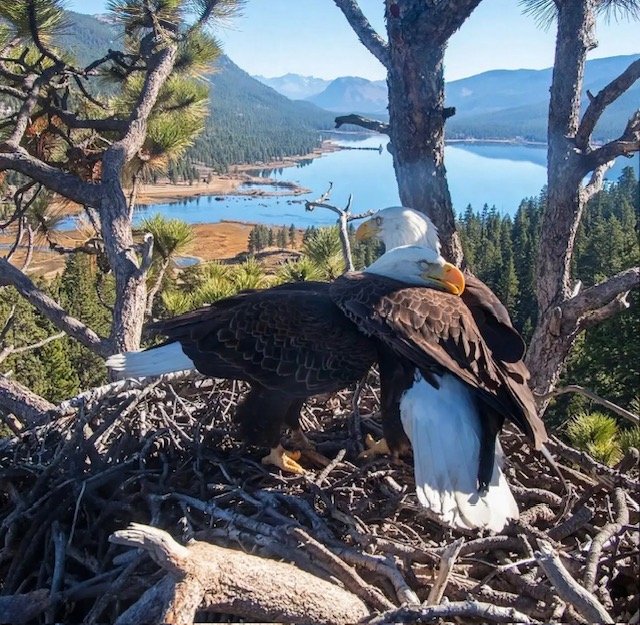
Jackie and Shadow. All photos are screenshots from the Friends of Big Bear Valley web camera www.bigbearvalley.org
I’ve been spying on a young family for years. Technically, I don’t think it’s spying because a camera that broadcasts their lives.
So, I guess I’m tuning in.
I’m talking about Jackie and Shadow, the bald eagles nesting in Big Bear Valley, California, watched by thousands of people around the world.
I first heard about them around Covid. People had been watching their nest camera and wondering whether this pair would ever manage to raise a family. Year after year, Jackie and Shadow laid eggs and something went wrong.
In 2019, one of the eaglets died after a snow and rainstorm. In 2020, the eggs never hatched. In 2021, a raven came into the nest and destroyed the eggs. People would tune in as snow piled on the nest covering Jackie while Shadow brought her food and kept watch.
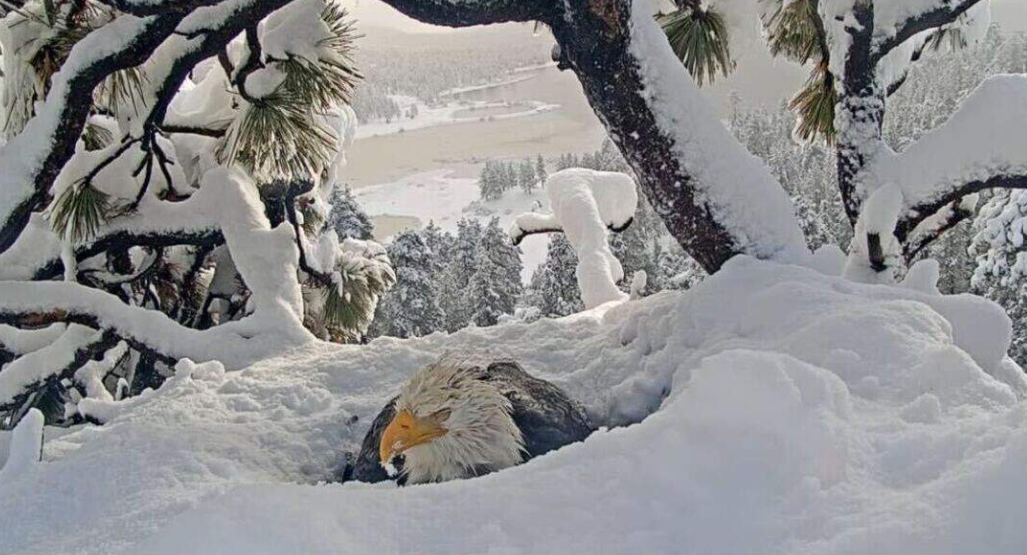
Jackie in their nest during a snowstorm.
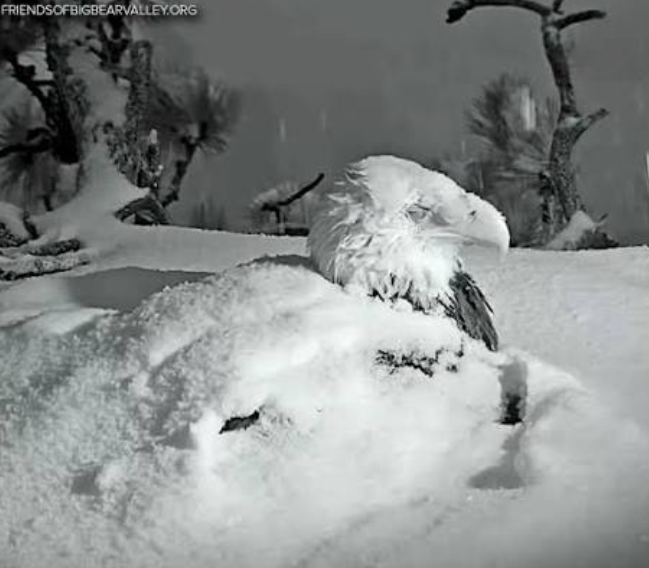
Jackie coated in snow during the snowstorm.
After multiple years of losses, viewers feared this couple would never have a family. There were Facebook groups, Reddit pages and articles dedicated to egg watch. People wondered how this pair would mentally cope if they weren’t able to lay and hatch eggs. Knowing that eagles mate for life only made these losses more stinging.
In 2025, egg-watchers cheered as Jackie laid two eggs and they hatched. People were so excited, Big Bear Valley set up a contest to names the eaglets. With more than 54,000 entries, Sunny and Gizmo were anointed.
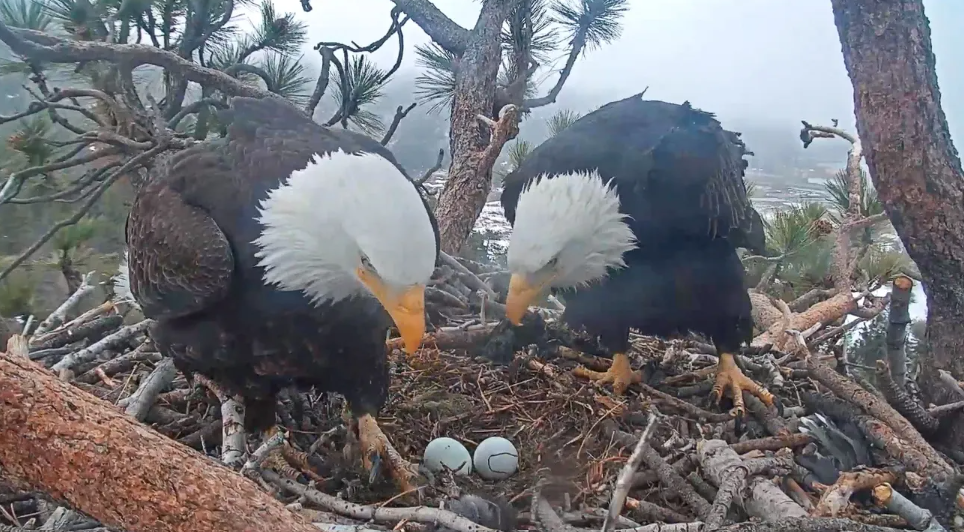
Jackie and Shadow standing over two eggs
The celebrations continued as people watched the eaglets grow. They watched Shadow and Jackie trying to feed them as they squirmed. They commiserated with Jackie’s exhaustion as the eaglets fussed. People held their breath as they took their first flights.
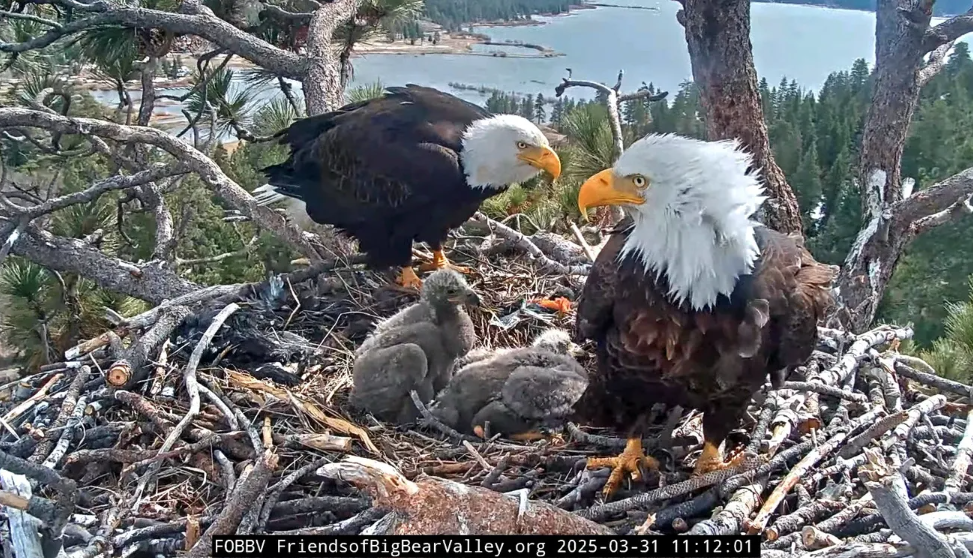
Jackie and Shadow with two eaglets.
The parasocial relationship people develop with these birds fascinates me. Why did we care so much? Why would thousands of people spend time watching two bald eagles sit in a nest?
Jackie and Shadow had something every great story has: a question we wanted answered. That question brought people back every season: Would they ever have a family?
We knew what they wanted
Jackie was one of the first bald eagle chicks hatched in the Big Bear Valley. In 2018, Shadow wooed his way into Jackie’s nest and she accepted him as her mate. A few years prior, Friends of Big Bear Valley (FOBBV) installed a camera next to the nest.
Their lives became a story that was remarkably easy for humans to understand. These two individuals found each other, wanted to start a family, and hoped that everything would work out.
This is a classic romance storytelling trope. Their lives contained the familiar human questions that made it meaningful. The fact that they were eagles made the story novel.
Novelty gets our attention. Familiarity gives us a way into the story.
We had a reason to come back
A good story creates a question that makes you want to know what happens next. It builds tension so you lean forward in your seat. Jackie and Shadow’s story was full of tension: would this be the year? Every nesting season brought the possibility of an answer. When the eggs appeared, people watched and wondered: would they hatch or face sudden loss and heartbreak? The next season began the same way: with eggs, waiting, and hoping.
That tension and uncertainty is one reason stories hold our attention. We don’t know the ending. If we did, there would be little reason to keep watching.
We filled in the emotions
We don’t actually know what Jackie feels or if Shadow thinks of himself as a husband or father. We have no idea whether they experience disappointment or pain when an egg doesn’t hatch. Yet we watched them and interpreted their behavior through emotions we understand.
When Shadow spread his wings over Jackie and the nest during a snowstorm, people saw protection. When eggs failed to hatch, people saw heartbreak. When the eaglets emerged, people saw joy. We projected the emotions and supplied the meaning.
The story didn’t tell us what to feel. It gave just enough information so that we could fill it in with how we felt.
Once we were emotionally invested, we couldn’t help but bring ourselves into the story. What would I feel about this loss? What would I do? Would I keep trying? Would I protect my family? Would I ever give up hope?
That is one of the most powerful things a story can do: give the audience space to see themselves.
We watched something change
Jackie and Shadow’s story evolved. They came together and navigated obstacles of lost eggs and eaglets. They waited through years of loss. Then there was a breakthrough when eaglets hatched, grew, and left the nest. The story kept moving.
This summer, the story took another turn.
In July, Jackie got in a fight with two other eagles. She fended off their attack with her talons but was injured and found grounded. She was taken to the Ojai Raptor Center. Despite two weeks of intensive care for severe anemia, she died on August 9.
Now people are watching Shadow. Does he know Jackie is gone? Will he return to the nest and find another mate? Will he recognize that the life in the nest has changed? Can he find hope in the future again?
A new eagle, Kaydee, has been seen at the nest. People will keep tuning in because the story isn’t finished. They want to see how Shadow navigates this stage of his life and what he builds next.
What makes a story worth listening to?
Jackie and Shadow remind us that a great story doesn’t require an extraordinary subject, only the right ingredients.
A character we care about
Something they want
An obstacle standing in the way
A question we need answered
Enough uncertainty to make us wonder what happens next
Emotion that gives us a reason to care
And room for the audience to participate.
When we tell stories, we often try to make the meaning unmistakable. We explain what happened, what it means, and how everyone felt about it. But with Jackie and Shadow, a camera showed us what was happening and we filled in the rest.
We turned two bald eagles into a family with hopes and disappointment. We worried about them, celebrated with them, and saw ourselves in them.
The best stories don’t do all the work for the audience. They give the audience space to do some of the work themselves. Next time you tell a story, don’t start with, “What information do I need to include?”
Ask:
What should my audience care about?
What do they want?
What’s standing in their way?
Where can I let the audience feel the story instead of explaining the feeling to them.
Sometimes the difference between information people hear and a story they remember is giving them a reason to care about what happens next.
***
Karen Eber is an award-winning author, TED speaker, and storytelling keynote speaker. She is the author of The Perfect Story and her TED Talk on how the brain responds to stories has been viewed more than 2.25 million times. As CEO and Chief Storyteller of Eber Leadership Group, she helps leaders communicate ideas that inform, influence, and inspire.