Interviews with Storytellers
I LOVE digging into how movies are made. Give me a director's commentary and I'm immersed in the choices made to bring the stories alive. The behind-the-scenes story always fascinates me.
Years ago, an interview with Rob Reiner caught my attention. You may know him from his days of acting in All in the Family. Or maybe you've loved movies that he directed like The Princess Bride, Stand by Me, Misery, or Sleepless in Seattle.
This interview focused on another fan-favorite he directed: When Harry Met Sally. He talked about the origin of the interview vignettes that take place throughout the movie.

Couples from the interview vignettes in When Harry Met Sally.
When preparing to make the movie, Rob Reiner was recently divorced. He was having dinner at a friend's house and the friend's father kept asking uncomfortable questions. Desperate to deflect the attention, he asked the father how he met his wife. Immediately, the father's eyes lit up and he was transported back to that day. He was nostalgic and animated as he described their meet-cute.
Rob recognized that people took on a softness and a sense of sentimentality when asked about how they met. This inspired the interview vignettes in the film. While they have nothing to do with the plot, they aid the overall idea of the movie: relationships take many paths and detours on their journey. Each interview provides a palate cleanser before the next scene.
I always wanted to include interview vignettes in The Perfect Story, sharing perspectives of different storytellers. Just like those in When Harry Met Sally, these are brief interviews that put a punctuation mark on the chapter. While the book takes you through a comprehensive approach to storytelling, these offer examples of the many different ways storytelling can be applied.
I made a dream list of people and was delighted to realize so many of those interviews. As I read through each I think "This one is my favorite!" There are golden nuggets in each. Interview vignettes include:
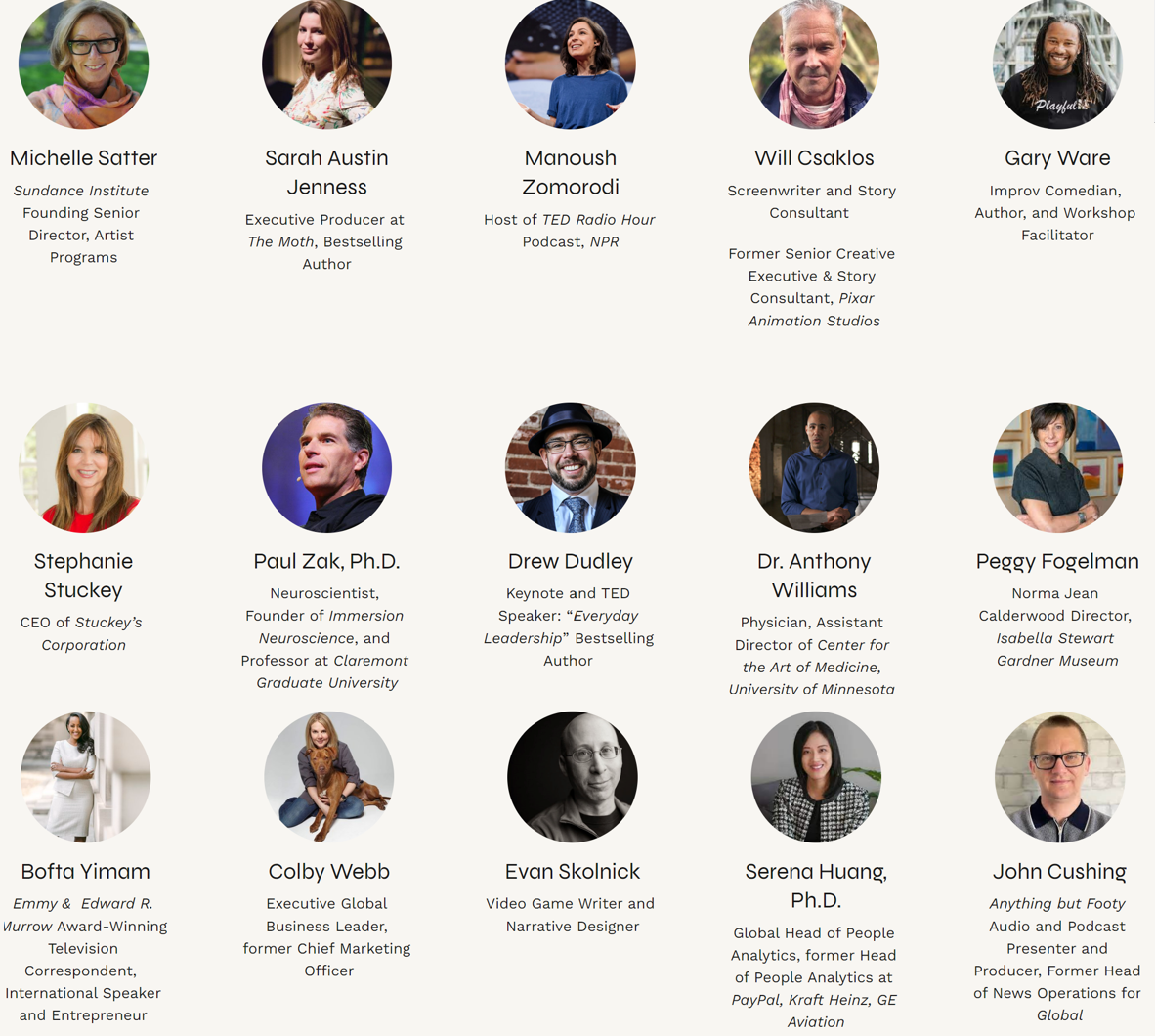
I interviewed 32 people and got so much rich content. Unfortunately, I was limited on what I could include due to word count limitations. I've been saving many of these pieces to share with you over the next several months.
They are the person's words, written in Q&A format and they share what you might learn if seated next to them at a dinner party. Each offers a fascinating glimpse into the person's world.
Pam Sherman as Erma Bombeck
I met Pam Sherman at a TED Women conference when she grabbed my jacket and wanted to know where I got it. Her vivacious energy caught my attention, and I knew I immediately wanted to know her. I was delighted to learn that she also worked in the leadership and storytelling space. Pam is a multi-hyphenate: actor, leadership consultant, and recovering lawyer.
In a few weeks, she is going to be starring in Erma Bombeck: At Wits End at the Cleveland Playhouse (July 29 - August 20th, 2023). If you are in the area, go see her in action. She is a delight in this fun and inspiring role.
Pam was one of the first interviews that I did. She spoke about playing Erma well before knowing she would take the stage as her again this summer.
I was unable to include Pam in the book, but wanted to share her with you here. For this first interview vignette, enjoy Pam Sherman and her philosophy on storytelling and how we all have to cross the believability gap.


Q: What role does storytelling play in your work?
A: Everything I’ve done has been rooted in story. From being an attorney to leadership consulting to writing a column about life in suburbia. I think stories are the rawest way to make people feel things, create clarity, and plant the seed of action.
I’m an actor by training. I spent two years performing Erma Bombeck on stage. Erma was a housewife turned writer and storyteller. She was the most widely distributed columnist in the United States for over 30 years. Each column told the story of what it was like to be a wife and mother of three kids. We can credit her as the precursor to today’s mommy blogs. Erma was an unexpected advocate for women that didn’t have a voice. She sought equal rights and changed the dialogue and perspective for women and equality through her stories. She saw herself as a vessel for women who didn’t typically have a voice.
Erma was a prolific columnist and humorous storyteller of her time. She wrote three columns a week in over 900 newspapers and was also a best-selling author of over 15 books. Her stories focused on her life and were packed with heart and humor. She saw herself as a journalist and wanted to tell the truth about what life was like as a wife and mother. She blazed the trail inspiring many people to write about their lives…me included! I wrote the Suburban Outlaw® column for the USA Today Network for 15 years.
Q: What did you learn from playing Erma?
A: When I played Erma, I gained so many leadership insights. The best outcomes always come from true collaboration. Theater is a team sport: an actor isn’t successful without lighting, set design, or cues. I learned to trust the director as someone I reported to and had my back. Everyone has those moments when they are standing in the dark in the wings, preparing to walk into the light. Maybe it’s the start of a Zoom call and trusting the slides or the technology will work. Or maybe it’s a leap of faith to step into leadership. That metaphor is so beautiful to me. I also recognized how hard it was to keep the performance fresh and full of energy. Everyone wants to feel like they are attending opening night. You can’t falter because it’s hard. You have to say the same thing over and over without losing the energy or passion you had the first time you said it.
In a few weeks, I will take the stage as Erma again at the Cleveland Play House. This time I want to go deeper into my illumination of her story. I want to mine the script to get as much out of it to take the audience on a journey. Telling Erma’s story from the stage has always been such an honor, and it’s made me a better storyteller. Working within a set script and timeframe helps you get to the point quicker. You make the story about the audience and not you, so they aren’t wondering why you are telling the story. And I believe it makes me a better story-sharer because sharing is generous, inclusive, and all about the impact on others – that’s my hope for all the audiences who will come to see Erma’s story.
Q: What is your approach to storytelling?
A: Stories are at the heart of everything I do. I consider myself like a spider weaving a web. I literally can find the story in everything. And I help other people find the thread of their stories and learn how to weave them into magic to share. So much of this work is giving people permission to tell a story and develop their storytelling muscle.
Storytelling should be a messy creative outlet. It’s a bit like throwing spaghetti at the wall to see what sticks. My storytelling process begins with me just putting out ideas to see what flows. I know once I get it out, I can fix it later. I’m a verbal person, so I tend to talk it out verbally and then write it down. And I practice my story on a variety of audiences – kind of like a comedian working material. Because storytelling is not a solo adventure. There is the story you intend and the one the audience experiences.
Even if I am telling someone else’s story, it becomes my story. I put myself inside it and find the specificity. I focus on what moves me about the story and figure out how to embody that when telling it. As an actor, I am always telling other people’s stories. They become convincing when I make them real by sharing the right amount of detail to make them vivid. Most people put too much unnecessary detail into the stories they are telling. It becomes a skill to learn the right amount of detail to help achieve the outcome you wish for your audience.
Great stories make you feel something. You can tell when a story is good when it makes someone think. Or creates the seeds of connection and impact. Or someone repeats it. Or makes you laugh. For me, laughter is always going to win over crying. The stories that fall flat often lack an objective and go on too long. Stories should be told for a reason. Without a purpose, it is hard to create a connection with the audience.
Q: The believability gap is core to your work…what is it?
A: My work in leadership and acting meet at bridging the believability gap: where you believe in yourself, and you get others to believe in you and your actions. It’s the topic I will explore in my forthcoming book. It’s ironic that the solution to this comes from the world of acting where you are playing someone else.
The best actors understand that they need to bridge a believability gap to get their audience to go on a storytelling journey with them to immerse themselves in the world of the play or movie. To believe the actors’ feelings and that they are going on that journey. That is what makes a transformational performance. It’s also what we want from our leaders. We want to believe what they are saying and doing and be transformed by them, so we too can transform.
Preorder The Perfect Story and get Jumpstart Your Storytelling for free!
Want to receive more articles like this one? Sign up for Brain Food here.